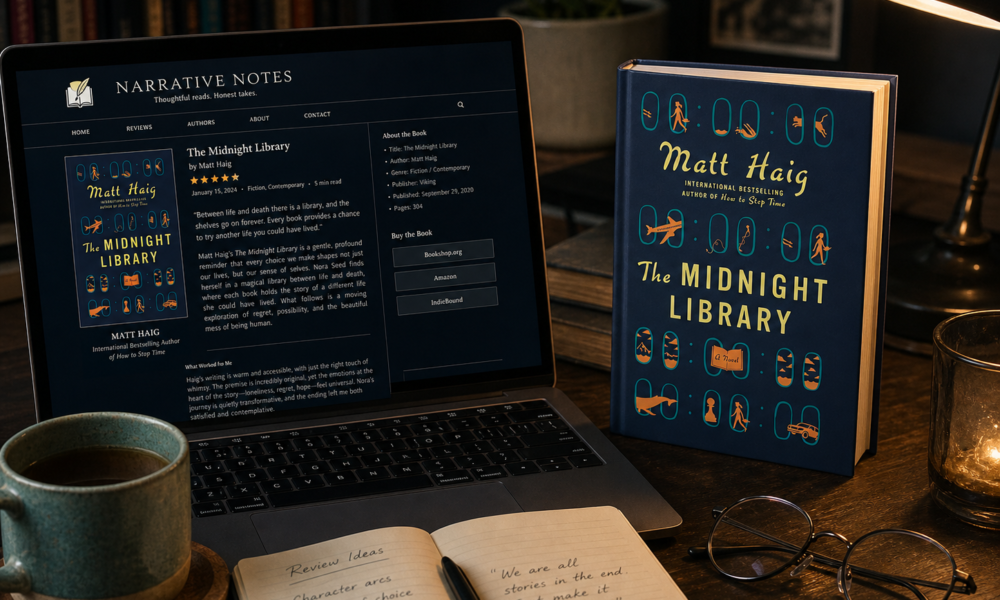

The Midnight Library is one of those novels that feels deceptively simple at first, then lingers because of what it is really trying to say about regret, loneliness, and the quiet ways a life can start to feel unlivable. I appreciated that Matt Haig does not default to writing Nora as “overtly dramatic” or emotionally performative. In a lot of books, a female protagonist in crisis is made louder than she needs to be for the story to work. Here, Nora’s emotional landscape is often restrained and internal, which made the premise feel more grounded and believable. At times, though, that restraint tipped into flatness, and I wanted a little more texture and mess in her emotional responses, not for melodrama’s sake, but to deepen her humanity.
What did land for me was how realistic the suicidal ideation felt compared to what I usually read. The book acknowledges that you do not need a single, obvious, “acceptable” trauma narrative for depression to become unbearable. Sometimes it is the accumulation: feeling like a failure, feeling stuck, loneliness, losing your pet, and waking up one day exhausted by the weight of not living up to your own potential. That aspect did not feel over-the-top or “emo”; it felt uncomfortably plausible, which gave the novel its strongest emotional credibility.
The library concept itself is genuinely clever, and I enjoyed watching the story test the fantasy of “what if I had chosen differently?” while also exposing how every life carries its own costs. That said, the message occasionally veered into preachy territory for me. Not everyone’s depression or suicidal thinking is improved by reframing regrets, sampling alternate outcomes, or being reminded that they “could have” made better choices. The book’s core idea is hopeful, but I do not think it will land well for every reader, especially someone currently in an active depressive episode or mood disorder state. For the right reader, though, it is a meaningful perspective-shifter.
One specific missed opportunity for me was Hugo. I wanted more about why he and Nora seemed connected and what that connection meant beyond plot function. He could have been a stronger thread of relational belonging, and he felt under-explored in a way that made me a little sad as a reader.
Overall, I enjoyed the novel, admired its grounded portrayal of despair, and thought the premise was executed with warmth even when I did not fully agree with the underlying takeaway. And as a nurse, I have to add: the dedication genuinely touched me.