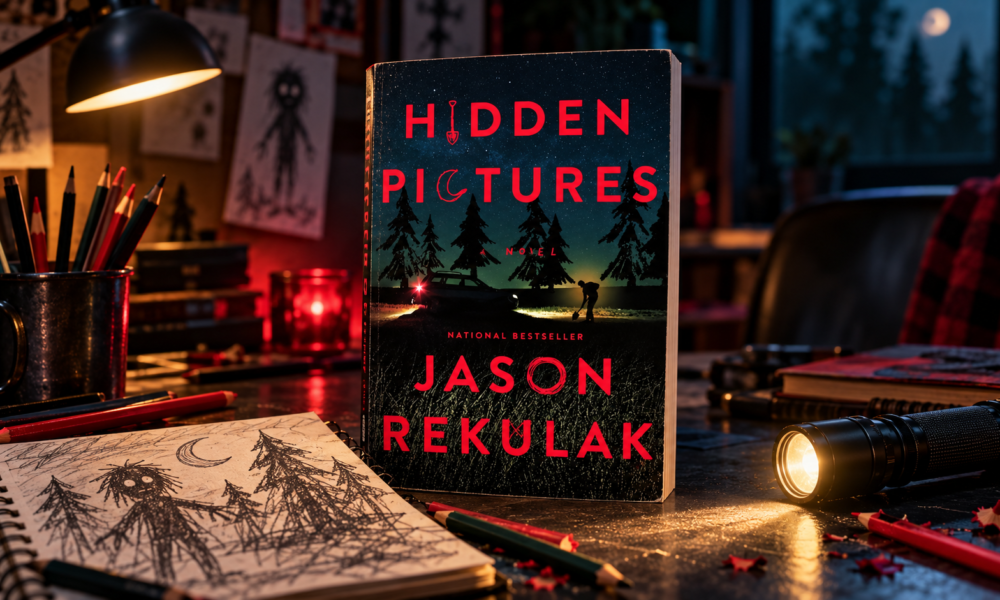
Hidden Pictures was one of those books that kept me entertained even while I was occasionally rolling my eyes at what I was reading. I enjoyed the mystery, the supernatural elements, and especially the concept of a young child’s increasingly disturbing drawings revealing something sinister. Unfortunately, some of the characterization and the eventual twist felt so heavy-handed that I had a difficult time taking the story entirely seriously.
My skepticism started with our protagonist, Mallory Quinn. We are introduced to her as a recovering heroin addict who has apparently gone from a fairly extreme substance abuse problem to being a squeaky-clean, deeply religious young woman who runs, prays, watches Hallmark movies, and seems almost comically wholesome. Obviously, people can change dramatically through recovery, and faith can absolutely be a meaningful part of that journey. That was not my issue. It was how unconvincingly the two versions of Mallory seemed to fit together. Her backstory felt designed to establish just how far she had fallen, while her present-day personality seemed equally determined to convince us how morally upright she had become.
I never completely bought it.
Then there were the Maxwells, Teddy’s wealthy, highly educated, nonreligious parents. Their strict household rules, particularly their insistence on science over religion, immediately established an ideological contrast with Mallory. At first, I thought this might create an interesting dynamic between people with very different worldviews. Instead, the parents increasingly felt like exaggerated representations of everything the book wanted us to distrust.
Even the eccentric, marijuana-smoking neighbor seemed written to reinforce certain stereotypes. I understand that thrillers need flawed characters, suspicious behavior, and a few red herrings, but eventually the characterization began feeling less like an exploration of complicated people and more like an exercise in assigning moral qualities based on their beliefs and lifestyles.
That said, I did enjoy the actual mystery. The drawings were a particularly effective storytelling device, and I appreciated how they became progressively more unsettling. Having the illustrations physically incorporated into the book added something that would have been difficult to achieve through written descriptions alone. I also liked the uncertainty surrounding whether Mallory was experiencing something supernatural or whether her history of substance abuse was affecting her perception of events.
For a while, I was genuinely interested in figuring out what was happening, and despite my complaints, I never really struggled to keep reading.
Spoilers Below:
Unfortunately, the final twist pushed the story into territory that felt a little too ridiculous for me.
The revelation that Teddy was actually Flora, a kidnapped little girl whose abductors had forced her to live as a boy to conceal her identity, was certainly unexpected. But the way the revelation was presented, particularly after spending so much of the novel establishing the parents as aggressively secular and ideologically rigid, felt incredibly on the nose.
To be clear, the Maxwells were disguising a kidnapped child to avoid getting caught, not raising a transgender child. Those are two very different situations. My criticism is about the way the novel uses that reveal alongside its earlier characterization of the parents.
In the current political climate, it was difficult for me not to read the twist as a thinly veiled commentary on gender identity and progressive parenting. The seemingly virtuous Christian protagonist ultimately exposes the horrific secrets of the wealthy, nonreligious parents, and the child’s forced gender presentation becomes a major component of their villainy.
Maybe that was not the author’s intention, but the combination felt a little too convenient to ignore. By the end, I felt like I had stumbled into a conservative cautionary tale disguised as a supernatural thriller.
And that was disappointing because I really did think the book had an interesting concept.
I also found the resolution somewhat overexplained. Once the mystery was revealed, the story seemed determined to tie everything into a neat little bow, including Flora’s recovery and return to her original identity. Given the extent of what she had experienced, that part felt a little too tidy for me.
Ultimately, Hidden Pictures lands at 3.5 out of 5 stars for me. I had plenty of complaints, but I also have to give credit where it is due. The story was interesting enough that I made it through fairly easily, and I never seriously considered adding it to my DNF (did not finish) list. For all the moments that made me question the author’s choices, I still wanted to know what happened next.
I think that is an important distinction. A book does not have to blow me away to be worth reading, and I can enjoy a story while still finding some of its elements ridiculous. Rekulak created an intriguing mystery with a unique visual component, and that was enough to keep me invested.
I just wish the characters had been written with a little more nuance and the final twist had relied less on what felt like ideological stereotypes.
Entertaining? Absolutely. Subtle? Not even a little.
An enjoyable, fairly quick read with an interesting premise, even if some of the execution left me shaking my head.