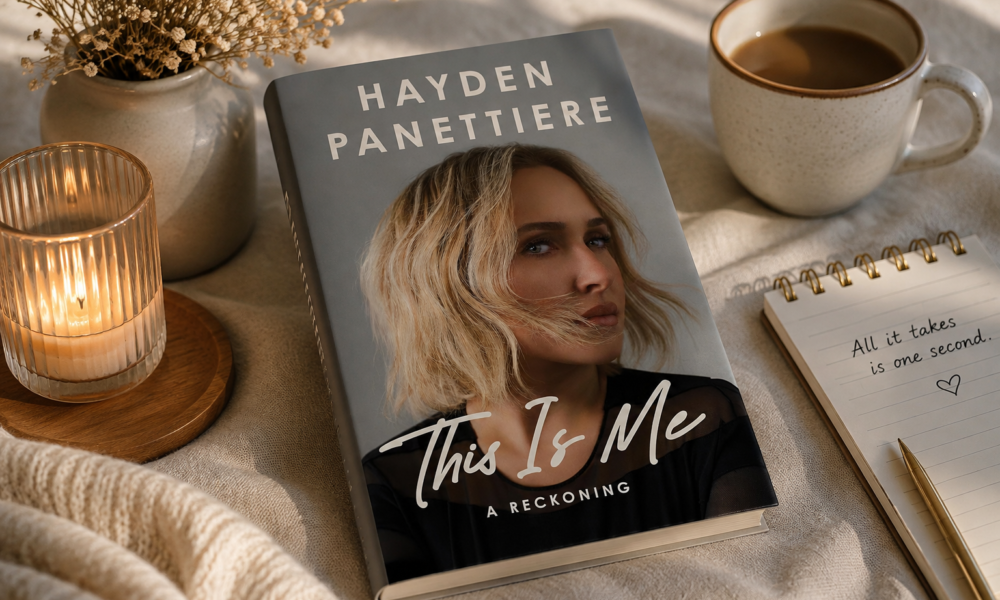

I went into This Is Me: A Reckoning under circumstances I obviously never expected. I read it after Hayden Panettiere passed away, and I think that inevitably changed the way some of her words landed for me.
I had always felt strangely drawn to Hayden. We were close in age, became mothers around roughly the same period of our lives, and from the outside, she always seemed surprisingly down-to-earth for someone who had essentially grown up in front of cameras. When I heard that she had died at only 36, it hit me harder than I expected. So, naturally, I became curious about the person behind the roles and headlines.
And wow, there was a lot more going on behind them.
Hayden begins the memoir from a place that actually feels hopeful. She writes about returning home, spending time with her father, grieving her brother Jansen, and finally giving her “mind, body, and soul some rest.” She describes herself as feeling “awake, alive, and hungry to challenge myself again.” Reading those words now is incredibly bittersweet.
What I appreciated most about the book is that Hayden does not seem interested in presenting herself as either a tragic Hollywood victim or some perfectly healed survivor. She takes the reader through child stardom, complicated family relationships, fame, motherhood, postpartum depression, addiction, relationships, abuse, grief, recovery, and the loss of her brother without pretending she always handled those things well.
Her discussion of her daughter Kaya was particularly difficult for me to listen to. Hayden openly acknowledges grieving the mother she expected to be while also making it clear how deeply she loved her daughter. There is something painfully human about admitting that loving your child tremendously does not automatically mean your life unfolds into the version of motherhood you imagined.
Listening to the audiobook rather than simply reading the text added another layer entirely. Hearing Hayden tell these stories herself made the funny moments funnier, but it also made the painful ones feel much more intimate. This was not an anonymous narrator recounting someone’s life after the fact. It was Hayden telling us, in her own voice, how she understood her life.
That matters even more now.
One of the central ideas Hayden returns to is that she does not want to be defined by the worst things that happened to her. She describes herself as a work in progress and views life as a continuing process of growth, complete with mistakes, grief, pain, and opportunities to rebuild. Near the end, she writes about finally finding greater empathy and understanding, including for herself, and says that her struggles ultimately helped her grow.
That is probably the hardest part of the memoir for me now.
She sounded like someone who was still very much working through things, but also someone who genuinely believed there was more life ahead of her. She had not tied everything into a neat little recovery bow, and I actually respected that. Recovery rarely works that way.
There has been reporting suggesting an overdose around the circumstances of Hayden’s death, but as of this review, her official cause and manner of death have not been determined, with toxicology and further investigation still pending. Because of that, I do not think it is fair to state definitively that she relapsed or died from an accidental overdose, especially when those closest to her have specifically asked people not to speculate while the investigation continues.
Still, knowing that her life ended so suddenly makes the hopeful tone of the book heartbreaking in retrospect.
I am giving This Is Me 4 out of 5 stars, and that rating is not out of sympathy or a feeling that I somehow owe the book an extra star because Hayden is gone. As a memoir, it does occasionally feel uneven, and the ending felt somewhat abrupt to me when I first reached it.
Now, though, that abruptness feels almost hauntingly appropriate.
There is no perfectly packaged conclusion because Hayden herself clearly did not believe she was finished. She repeatedly describes herself as still growing, still healing, still becoming someone new. Even the book’s dedication thanks “every hand that lifted me, every obstacle that strengthened me, and every lesson that led me here.”
She thought there would be another chapter.
So did everyone else.
I am glad Hayden got the opportunity to tell this much of her story herself, in her own words and, if you listen to the audiobook, literally in her own voice. Whatever ultimately comes from the investigation into her death, I do not want the circumstances of her final day to become the defining story of her life. After listening to This Is Me, I do not think Hayden would have wanted that either.
It is messy, funny, painful, self-aware, occasionally frustrating, and unfinished.
In other words, it feels like a life.